Koraido
A Princess of MarsKorad is an abandoned city on the bed of a long-dead Martian sea, a remnant of an ancient harbor and cultural center whose history illuminates the planet’s vanished civilizations. Its imposing but empty buildings become the setting for John Carter’s first meeting with Dejah Thoris and for her appeal to the green Martians to abandon their isolating customs and join the red Martians in preserving their dying world.
Setting and Ruins
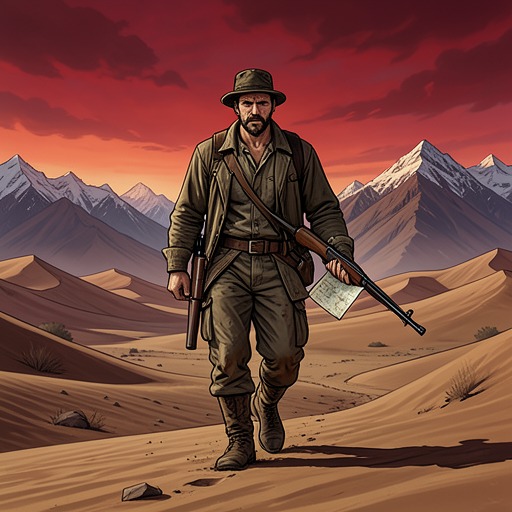
John Carter and his captors reach Korad after traveling roughly ten miles from the place where they encountered one another, ascending toward the edge of an extinct sea and passing through a narrow mountain gorge. The city stands on a low tableland beyond an open valley. A ruined roadway leads from the city to the edge of the tableland, where it terminates in a broad flight of steps. The approach makes the settlement’s former scale legible even as its road ends abruptly in abandonment.
Korad’s buildings are deserted and not greatly decayed, but appear to have been uninhabited for years, perhaps ages. Around a large central plaza, the green Martians have made a temporary camp in the surrounding structures. The contrast is striking: roughly nine or ten hundred present-day warriors occupy a city whose surviving architecture suggests a much older and more refined society. Its rooms retain large windows, mural paintings, mosaics, and traces of elaborate decoration, yet the place is inhabited by people whom John Carter regards as having little in common with the architects who made it.
A Meeting in the Plaza
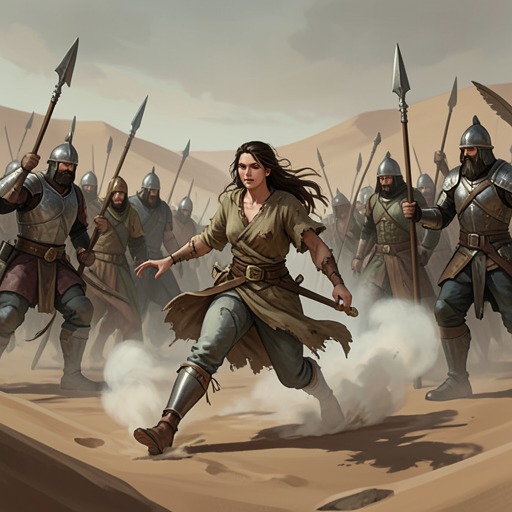
The plaza and its surrounding buildings bring the city’s present occupants and its political tensions together. After John Carter is taken before the green Martian leaders, he is sent with Sola to a chamber in a building facing the plaza. Later, as he and Sola enter the plaza, he sees a prisoner from a red Martian aircraft being dragged into a nearby building by green Martian women. The captive is Dejah Thoris, whose appearance immediately distinguishes her from her captors and whose imprisonment establishes the danger at the heart of the encounter.
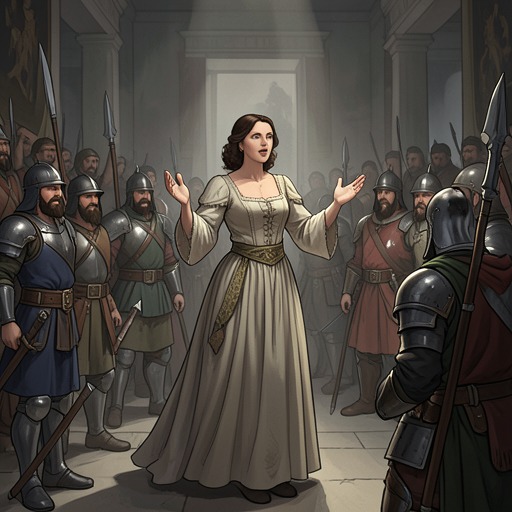
Korad also becomes the setting for Dejah Thoris’s forceful address to the green Martian leaders. She explains that her expedition had been a peaceful scientific mission, dispatched to chart air currents and measure atmospheric density. She argues that the red Martians’ work sustains the air and water supply on which all life on Mars depends, despite what she calls the green Martians’ interference. Her appeal turns the abandoned city into more than a refuge or prison: among the ruins of a shared planetary past, she asks its occupants to choose cooperation over continued isolation and extinction.
The Lost Harbor and Mars’s Past
Dejah Thoris identifies Korad as a former center of commerce and culture, built beside a beautiful natural harbor sheltered by hills. The small valley on the city’s western side is all that remains of the harbor; the pass through the hills toward the old sea bottom once served as the channel by which ships reached the city gates. The visible geography thus preserves the outline of a vanished maritime world: valley, pass, and empty seabed mark the route once followed by water and trade.
Korad belongs to a larger pattern of settlements along the shores of Mars’s ancient seas. As the waters receded, people followed them toward the shrinking oceans; eventually, necessity drove them to construct the canals that Dejah Thoris describes as their ultimate means of survival. The city’s ruins therefore record not simply political decline but adaptation to environmental loss, connecting its former prosperity to the same planetary crisis that makes the red Martians’ atmospheric and water-maintenance work urgent.
Narrative Significance
Korad’s layered history sharpens the story’s contrast between cultural inheritance and present conduct. The city’s murals, mosaics, and harbor testify to a cultivated past, while its present use as a green Martian camp exposes the gap between that past and the brutal customs Dejah Thoris challenges. The address is not merely a plea delivered in a convenient public place: its setting makes the possibility of a shared civilization visible in the stones around the listeners, even as their response remains uncertain.
The city also ties the plot’s immediate events to the larger fate of Mars. Its lost harbor embodies the retreat of the seas; its surviving canals belong to the later struggle to keep the planet habitable; and the prisoner brought into its plaza speaks for a people trying to sustain that effort. Korad is at once a deserted monument, a temporary center of green Martian power, and the meeting ground where the prospect of cooperation briefly confronts entrenched custom.